How the Human Liver Works: Anatomy, Functions, and How to Keep It Healthy
The liver is the body's largest internal organ and its main chemical processing plant — a roughly 1.5-kilogram, wedge-shaped gland tucked under the right ribs that filters blood, makes bile for digestion, stores nutrients, and manages hundreds of metabolic reactions. It is also the only visceral organ that can regrow itself, sometimes recovering to a full working size from as little as a quarter of its original tissue. Understanding how it works — and what actually helps or hurts it — is one of the more useful things you can do for long-term health, since liver damage from fat, alcohol, or medications usually causes no symptoms until it's advanced.
Key takeaways
The liver performs an estimated 500+ distinct biochemical functions, including detoxification, bile production, and manufacturing nearly all blood proteins.
It has a unique dual blood supply — about 75% from the nutrient-rich portal vein and 25% from the oxygen-rich hepatic artery.
The liver can regenerate after losing up to 70–90% of its mass, often restoring itself within weeks to months.
Fatty liver disease (MASLD) now affects an estimated 100 million American adults, and most don't know they have it.
Elevated ALT and AST on a blood panel are the earliest common clue of liver stress, often showing up before symptoms do.
Diet, alcohol reduction, and weight management outperform any supplement for liver health, though targeted formulas like Liver Support can complement those habits.
What does the liver actually do?
The liver sits in the upper right abdomen, just below the diaphragm, and is often described as having over 500 jobs. It performs over 500 tasks, including detoxification, protein synthesis, and the production of digestive enzymes. Three functions matter most day to day:
1. Metabolism and nutrient storage
The liver processes nutrients such as lipids, proteins, and glucose, and plays a significant role in maintaining normal blood sugar levels by converting glycogen to glucose and vice versa. It also regulates blood levels of amino acids, processes hemoglobin for its iron content, and converts poisonous ammonia into urea for excretion in urine. This is part of why liver health is closely tied to metabolic conditions — a connection covered in more depth in our guide to choosing a blood sugar supplement.
2. Detoxification
The liver filters and removes compounds from the body, including hormones such as estrogen and aldosterone, as well as compounds from outside the body, including alcohol and other drugs. At the cellular level, Kupffer cells help handle bacteria, while hepatocytes are abundant in smooth endoplasmic reticulum, an organelle that plays a crucial role in detoxification. This is the biological reality behind popular "detox" marketing; the liver is genuinely built for this job, which is why our articles on liver detoxification and a sensible detox and cleansing routine focus on supporting it rather than replacing it.
3. Protein synthesis and bile production
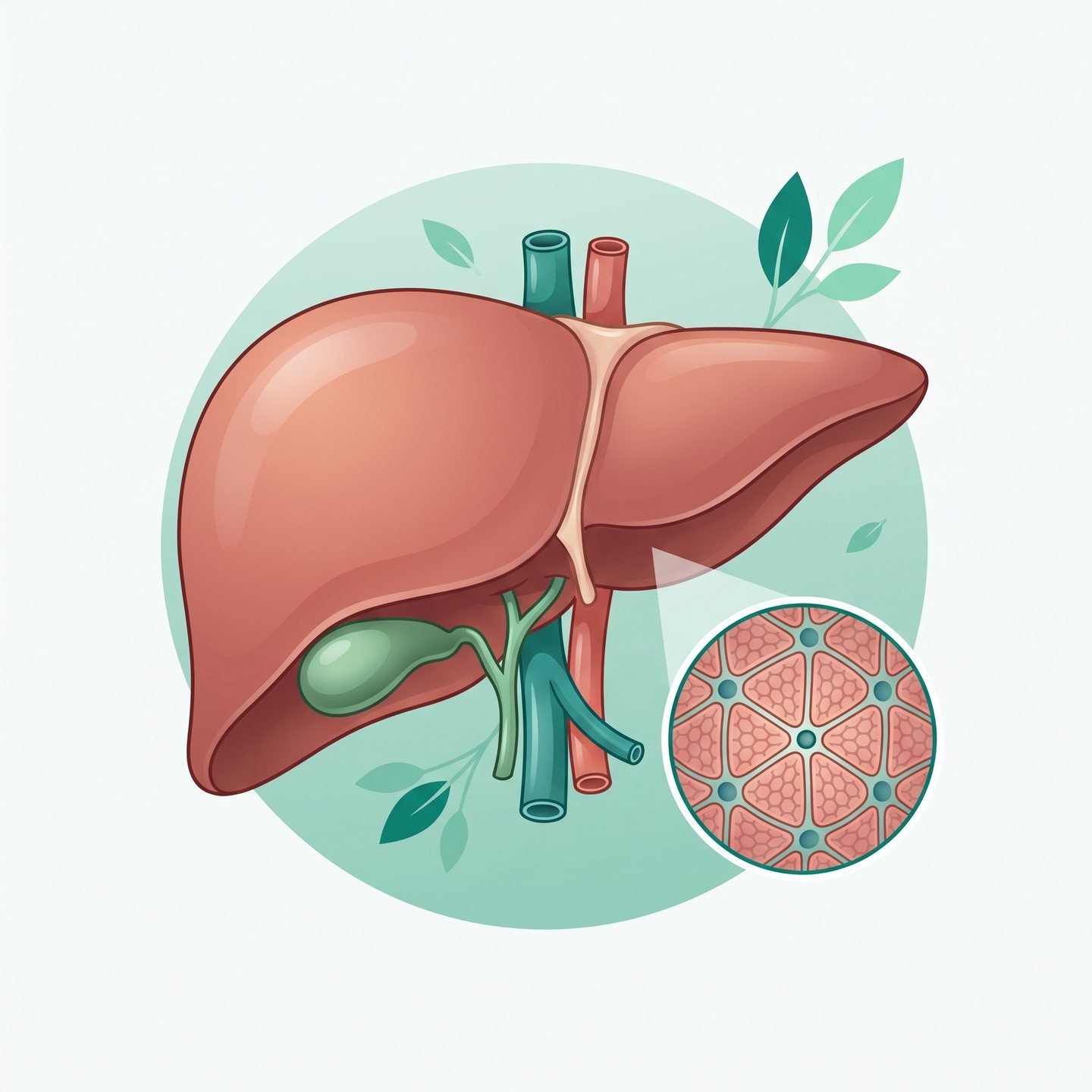
The liver is responsible for producing 90% of the plasma proteins in your blood, including albumin and clotting factors. It also produces bile, which helps carry away waste and break down fats in the small intestine during digestion. Bile flows from the liver through the bile canaliculi into ducts that lead to the gallbladder for storage and release during meals — the network shown in the "hepatic lobule" anatomy in liver diagrams.
How is the liver structured?
The liver is roughly triangular and consists of two lobes: a larger right lobe and a smaller left lobe, separated by the falciform ligament. At the microscopic level, the organ is built from repeating hexagonal units called lobules. The functional unit of the liver is the lobule, and each lobule is hexagonal, with a portal triad — portal vein, hepatic artery, and bile duct — sitting at each corner.
The liver's blood supply is unusual among organs. The liver has a dual blood supply from the portal vein (approximately 75%) and the hepatic artery (approximately 25%). The portal vein carries nutrient-loaded blood straight from the intestines, so the liver is often the first stop for anything you eat, drink, or swallow — nutrients, alcohol, medications, and toxins alike.
Bile canaliculi and the "chicken-wire" network
Bile canaliculi form a lattice-like network sometimes described as a "chicken-wire pattern," which increases the surface area for bile flow — and notably, bile and blood flow in opposite directions to each other within the liver.
How much can the liver regenerate?
This is one of the liver's most remarkable traits. The liver has a unique capacity among organs to regenerate itself after damage, and can regrow to a normal size even after up to 90% of it has been removed. Research modeling this process shows even if up to 70 percent of the liver is removed, the remaining tissue can regrow a full-sized liver within months. At a minimum, only about 10% of the original liver mass is required for the organ to regenerate back to full size.
This regenerative ability is what makes living-donor liver transplants possible, and it's also why liver disease can progress silently for years — the organ compensates for damage long before symptoms appear. But regeneration has limits: the liver isn't invincible, and many diseases and exposures can harm it beyond the point of repair. Chronic overload — from alcohol, viral hepatitis, or fat accumulation — eventually overwhelms that capacity.
What are the warning signs of liver trouble?
Liver problems are usually caught on a routine blood panel before they cause noticeable symptoms. The two enzymes doctors check most often are ALT and AST.
Test | Typical normal range | What it usually means when elevated |
|---|---|---|
ALT (alanine transaminase) | ~7–56 U/L | More specific to the liver; often the first marker to rise with fatty liver or drug-related stress |
AST (aspartate transaminase) | ~10–40 U/L | Found in liver, heart, and muscle, so it's less liver-specific than ALT |
Mild elevation | 2–5x upper limit | Common; often reversible with lifestyle changes |
Severe elevation | >15x upper limit, or >1,000 IU/L | Suggests acute injury (e.g., drug toxicity, acute viral hepatitis) and needs prompt medical evaluation |
Typically the range for normal AST is reported between 10 to 40 units per liter and ALT between 7 to 56 units per liter, and elevated levels of liver enzymes in general signify some form of liver damage or injury. Importantly, elevated liver function tests are found in approximately 8% of the general population, and up to 30% of asymptomatic elevations are transient, resolving within 3 weeks. That said, persistent elevation always deserves a conversation with a doctor rather than guesswork.
How common is fatty liver disease?
Fatty liver disease — now officially renamed Metabolic Dysfunction-Associated Steatotic Liver Disease, or MASLD — has become the most common chronic liver condition worldwide. MASLD represents one of the fastest-growing health crises in the United States, now affecting approximately 100 million adults. Globally, NAFLD/MASLD, driven by obesity and lifestyle changes, affects approximately 25% of the world's population.
What makes this especially concerning is how quiet it is. More than 100 million Americans are estimated to be living with some form of fatty liver disease, and the vast majority of them don't know it, as the condition progresses silently for years — often decades — with no symptoms. Projections suggest the trend keeps climbing: by 2050, an estimated 122 million adults, or 41% of the U.S. population, will have this condition. This is closely tied to metabolic health generally, which is part of why we cover related topics like magnesium and vitamin D3 and K2 as broader supports for metabolic function.
What actually supports liver health?
The most effective interventions are boring but proven: limiting alcohol, maintaining a healthy weight, staying current on hepatitis vaccinations, and avoiding unnecessary medication overload. Diet-based approaches, including reducing processed sugar and increasing fiber and produce intake, are discussed in our pieces on detoxifying foods and a whole-body detox approach.
Where do liver supplements fit in?
A handful of ingredients have real, if mixed-quality, clinical evidence behind them:
Milk thistle (silymarin): the most studied liver botanical; its active compound works on multiple fronts, blocking inflammatory signaling, acting as an antioxidant, and stimulating enzymes that promote growth of new liver cells.
NAC (N-acetylcysteine): NAC has the strongest acute toxicity evidence and is FDA-approved for acetaminophen overdose.
TUDCA: TUDCA has been FDA-approved for cholestatic liver diseases based on its ability to protect hepatocytes and promote bile flow, working by inhibiting programmed cell death and reducing cellular stress rather than acting primarily as an antioxidant.
These ingredients work best as a complement to — never a replacement for — the fundamentals. As one clinical review summarizes plainly: "The liver doesn't need 'detox,' it IS your detox system." Formulas combining these researched compounds, like Liver Support with milk thistle, NAC, turmeric, and TUDCA, are built around ingredients with the most consistent human data rather than proprietary blends of unclear doses — you can get it here if you want a daily formula that covers these bases. If you're not sure where your liver health stands relative to your diet, alcohol use, and supplement stack, the free AI health assessment can help connect the dots and suggest next steps based on your own habits.
Liver anatomy quick reference
Feature | Detail |
|---|---|
Location | Upper right abdomen, below the diaphragm |
Weight | ~1.5–1.8 kg in adults |
Lobes | Right (larger) and left (smaller) |
Blood supply | ~75% portal vein, ~25% hepatic artery |
Functional unit | Hepatic lobule (hexagonal, with portal triads at corners) |
Regenerative capacity | Can regrow from as little as ~10–25% of original mass |
Frequently asked questions
Can the liver really grow back?
Yes. The human liver can regenerate to full size from just 25% of its tissue, and other research shows this can happen even after up to 90% removal in some cases. This regenerative ability is what makes liver resection surgery and living-donor transplants possible.
What are the earliest signs of liver damage?
Most early liver damage causes no obvious symptoms at all. It's typically discovered through routine bloodwork showing elevated ALT or AST. When symptoms do appear — fatigue, upper right abdominal discomfort, or yellowing of the skin or eyes (jaundice) — the liver has often already sustained meaningful damage, which is why regular checkups matter.
How much alcohol is too much for liver health?
There's no universally "safe" amount, but risk rises with both quantity and frequency. Chronic heavy drinking is one of the most common preventable causes of liver enzyme elevation and, over years, cirrhosis. Cutting back or eliminating alcohol is consistently one of the most effective single steps for liver health.
Does fatty liver disease always progress to serious damage?
No, but it can. Simple fatty buildup (steatosis) doesn't always progress, but a portion of cases advance to inflammation (steatohepatitis), then fibrosis, and eventually cirrhosis. Annually, an estimated 0.25–3.2% of people with NAFLD/MASLD develop cirrhosis, and 0.3–2.6% of those with cirrhosis develop liver cancer. Early lifestyle changes make the biggest difference in preventing progression.
Do liver "detox" or "cleanse" supplements actually work?
The liver detoxifies the body on its own around the clock; no supplement flushes out toxins overnight. What research does support is that specific, well-studied ingredients like milk thistle, NAC, and TUDCA can support liver enzyme levels and cellular resilience over time, particularly alongside diet and alcohol moderation — not as a substitute for them.
What blood test checks liver health?
A standard liver panel checks ALT, AST, alkaline phosphatase (ALP), bilirubin, and albumin. Normal blood ALT and AST levels generally range from 0 to 40 IU/L, though exact reference ranges vary slightly by lab. Persistent abnormal results should always be followed up with a doctor rather than interpreted alone.
This article is for education and is not medical advice.
Sources
Share this