When Your Nerves Can’t Get Their Message Through

You know that feeling. Your toes feel cold even though they’re warm. Your fingers buzz like a phone on silent. A light touch from a bedsheet feels heavy on your ankles at night. If you’ve ever wondered, what’s happening in there? — this is for you.
We’re talking about peripheral neuropathy — the word doctors use when the nerves that run from your brain and spinal cord out to your hands, feet, and the rest of your body aren’t doing their job the way they should. About 1 in 10 people over 40 deal with some form of it. Most never get a clean reason why.
The good news: a lot of the things that make neuropathy feel so stubborn are now understood well enough to work with — not by masking symptoms, but by supporting the conditions those nerves need to actually function.
Why Nerves Stop Working Well
Your nerves run on tiny electrical signals. For those signals to fire cleanly, three things need to be working together:
Circulation — nerves need steady blood flow to deliver oxygen and clear waste.
Cellular energy — nerve cells use a lot of ATP (the cell’s energy currency). Anything that drags that down throws off signal quality.
Balanced inflammation — chronic, low-grade inflammation is one of the most common things that slowly irritates and damages nerve fibers over time.
When one or more of those breaks down, the signal gets distorted on the way to your brain. That’s why neuropathy shows up as tingling, burning, numbness, or shooting pain. It’s not “in your head” — it’s a real electrical communication breakdown at the tissue level.
Diabetes, long-term inflammation, certain medications, injuries, circulation issues, and just plain aging are the usual suspects. But even when the cause is unclear, the nerves are still asking for the same basic things: better flow, better energy, calmer inflammation.
Why “Just Dealing With It” Usually Doesn’t Work
Most conventional neuropathy care is built around blocking the pain signal at the nerve or in the brain. That’s helpful in the short term, but it doesn’t address what’s actually causing the signal to be distorted in the first place.
That’s why there’s been growing interest in approaches that support the underlying conditions — better circulation, better cellular energy production, a calmer inflammatory response. The goal isn’t to mask anything. It’s to give the nerve what it needs to do its job again.
PEMF: A Different Way In
PEMF stands for pulsed electromagnetic field. It’s a well-studied therapy that uses low-energy electromagnetic pulses — similar in strength to the fields your body already produces naturally — to nudge cells into more efficient behavior.
For more than 50 years, NASA, orthopedic surgeons, and researchers have studied PEMF for bone healing, wound repair, and circulation support. What they found is consistent: cells respond to specific electromagnetic patterns with measurable changes in:
Circulation and oxygen delivery — PEMF has been shown to support nitric oxide production, which helps blood vessels relax and feed tissues.
Cellular ATP production — mitochondrial activity (the cell’s energy engine) tends to tick up under PEMF exposure.
Inflammatory signaling — chronic, stuck inflammation often softens when the right frequency patterns are present.
Different problems need different patterns. That’s where one of the more interesting recent devices comes in.
The Resona Health Vibe
Most PEMF devices use a single frequency, or a simple sweep. The Resona Health Vibe does something different. It uses what the company calls frequency chord protocols — sets of two coordinated frequencies delivered together, sequenced over 30 minutes to 2 hours, depending on the protocol selected.
The chord idea is borrowed from how music works. A single note is one signal. A chord is several notes played at once — the brain (and the body) responds to the relationship between them, not just each one individually. The Vibe treats nerve and tissue support the same way: paired frequencies chosen to work together toward a specific goal.
Resona Health recommends four synergistic protocols for nerve health:
Fibromyalgia Protocol — addresses hypersensitive nerve pathways and chronic nerve discomfort, often used alongside other therapies.
Brain Wave Theta Protocol — sits around 6 Hz, in the theta brain wave range, traditionally associated with pain support and relaxation.
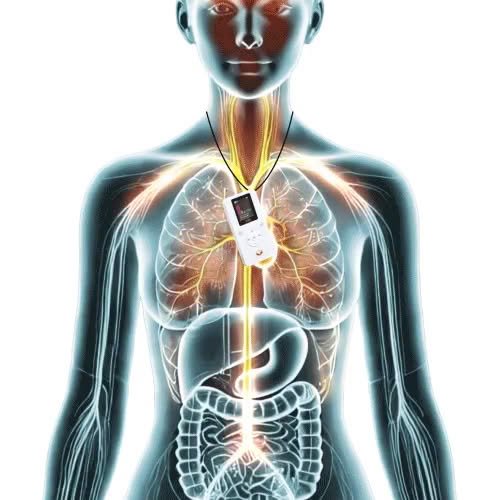
Vagus Nerve Protocol — targets the vagus nerve, a key channel between brain and body that helps regulate inflammation and recovery.
General Inflammation Protocol — addresses inflammation around nerves, which is one of the most common contributors to ongoing discomfort.
Sessions are typically 30 minutes to 2 hours. Many people wear the device in a pocket, around the neck with a lanyard, or in a bra. It’s small, passive, and doesn’t require you to be still — it works while you move through your day.
What To Expect (Realistically)
Nothing works overnight. The honest expectation for a frequency-based wellness approach like this:
Some people feel a shift in sensation within the first few sessions — less burning, more feeling coming back.
Most people notice a gradual change over 2–4 weeks of consistent use.
A few people don’t feel much until they pair the device with movement, hydration, and better sleep.
Because PEMF is supportive, not curative, the best results tend to come from combining it with the basics — walking, hydration, blood-sugar management if that’s a factor, and working with a practitioner on any underlying condition driving the neuropathy.
It’s also worth saying: PEMF has been cleared by the FDA for certain uses (bone healing, for example). It’s not a miracle. It’s a tool, and like any tool, it works best as part of a larger plan.
Should You Try It?
If you’ve been dealing with tingling, burning, or numbness — especially in your feet or hands — and you’ve been told “just live with it,” the Resona Health Vibe is worth a serious look. It’s not the only option out there, but the four-protocol approach is unusually thoughtful, and the device itself is one of the more accessible ones on the market.
👉 Learn more about the Resona Health Vibe at resona.health/go/j2zhk2sz
Affiliate Disclosure: This post contains an affiliate link to the Resona Health Vibe. If you purchase through the link, we may earn a small commission at no extra cost to you. We only recommend products we genuinely believe in.
Share this