How Do Lungs Work? A Clear Guide to Lung Anatomy, Breathing, and Keeping Yours Healthy
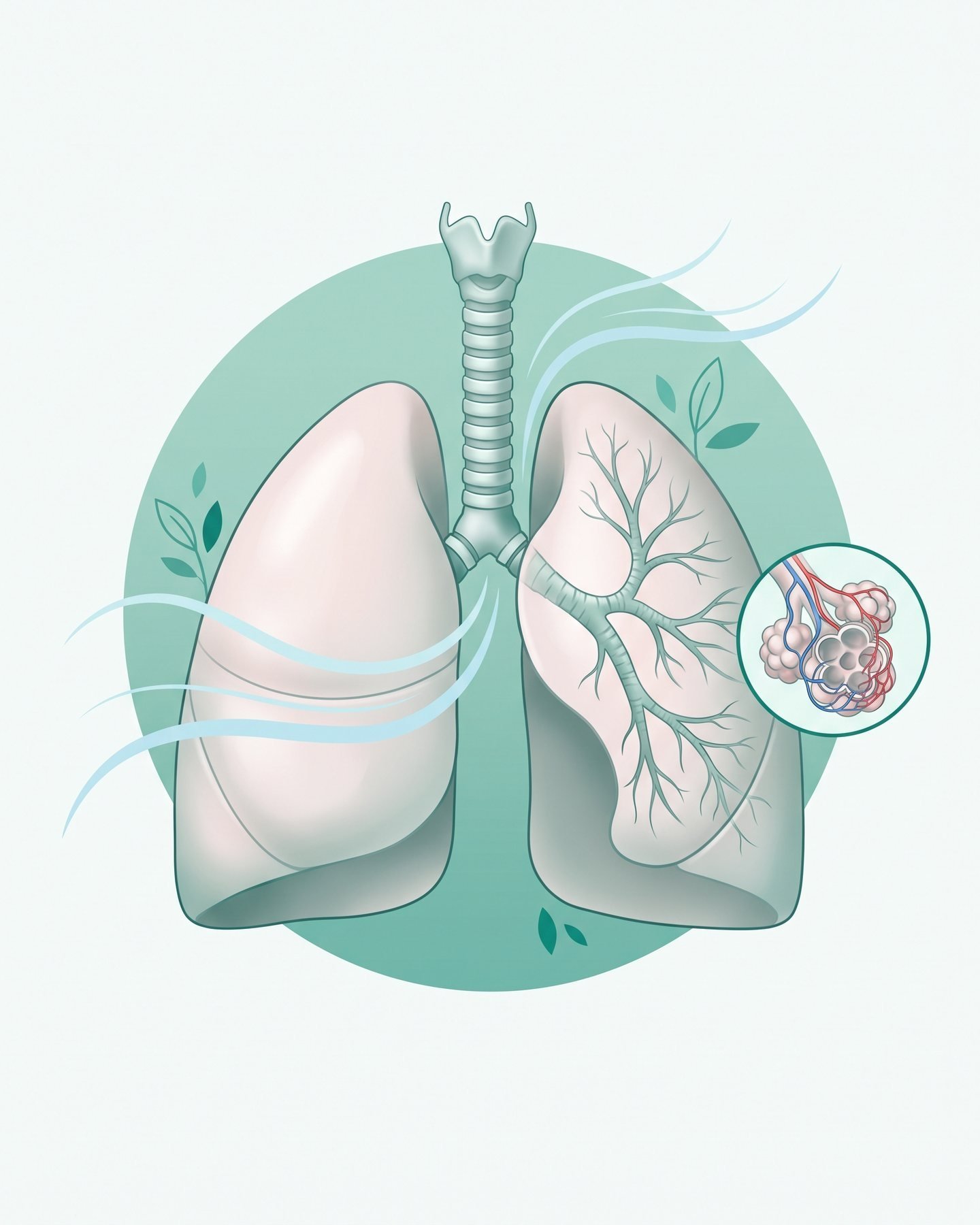
Your lungs work by pulling air down a branching network of tubes until it reaches roughly 300 million tiny air sacs called alveoli, where oxygen crosses into your blood and carbon dioxide crosses out. This happens automatically about 20,000 times a day, powered mainly by your diaphragm, and it's the single most important gas exchange your body performs every minute of your life. Understanding the steps helps explain why habits like smoking, air quality, and even diet can measurably change how well you breathe.
Air path: nose/mouth → trachea → bronchi → bronchioles → alveoli, then back out again.
Gas exchange happens only in the alveoli, where oxygen moves into capillary blood and CO₂ moves out to be exhaled.
The diaphragm, not the lungs themselves, does most of the mechanical work of breathing.
Surface area matters: unfolded, your alveoli cover an area close to a tennis court, which is what makes fast gas exchange possible.
Lifestyle habits—not smoking, exercise, air quality, and an anti-inflammatory diet—are the biggest levers for lung health you can control.
What Are the Main Parts of the Respiratory System?
Air enters through your nose or mouth and travels down a tube called the trachea, or windpipe. From there it's a story of branching: the trachea splits into two bronchi, one per lung, which then divide again and again into smaller bronchioles, ending in clusters of alveoli, the microscopic air sacs where the real work happens. According to the American Lung Association, the surface area of both lungs is roughly the same size as a tennis court and the total length of the airways running through them is 1,500 miles, which is roughly the distance from Chicago to Las Vegas. Two other structures matter for how lungs move: the pleura, a thin, slippery double-layered membrane that lets the lungs slide smoothly inside the chest, and the diaphragm, a dome-shaped muscle beneath the lungs that does most of the mechanical work of breathing. The diaphragm is the strong wall of muscle that separates the chest cavity from the abdominal cavity, and by moving downward it creates suction in the chest, drawing in air and expanding the lungs.
Why Are the Two Lungs Different Sizes?
The right lung is divided into three lobes while the left lung has just two, leaving room on the left side for the heart. This asymmetry is normal anatomy, not a sign of anything wrong.
How Does Gas Exchange Actually Work in the Alveoli?
Each alveolus is wrapped in a mesh of capillaries so thin that gases can pass straight through the shared membrane. Alveoli are wrapped in tiny blood vessels called capillaries, and the air you breathe in fills these air sacs with oxygen-rich air — this is where the exchange of gases occurs. Blood arriving at the alveoli is loaded with carbon dioxide and low on oxygen; air in the alveoli is the opposite. Oxygen and carbon dioxide pass through these capillaries into the air sacs: as oxygen crosses over into the capillaries, red blood cells capture it, while carbon dioxide is unloaded into the lungs, and the oxygen-rich hemoglobin is transported throughout the body as the lungs exhale the carbon dioxide.
This trade only works because of the sheer number of alveoli and their combined surface area. The total surface area of the alveoli is about 80 square meters, while the total external surface area of the lungs is only about 0.1 square meters — subdividing into alveoli increases the surface area in contact with blood by a factor of almost 1,000. Roughly 2,400 kilometres of airways and 300 to 500 million air sacs pack into a space that fits inside your ribcage. If the alveoli are damaged, as happens in emphysema, that surface area — and your ability to get oxygen into your blood — shrinks. Emphysema, for instance, is characterized by irreversibly damaged and lost alveoli, as some of the air sacs rupture.
How Many Times a Day Do You Actually Breathe?
At rest, most people breathe in and out anywhere from 12 to 15 times per minute, and the American Lung Association notes that lungs are on the clock 24 hours a day, 365 days a year, breathing 12 to 15 times a minute — translating to 17,000 breaths a day or more than 6 million breaths a year, with no vacation days. Other estimates put the daily total closer to 20,000 breaths depending on activity level and age; the average resting respiratory rate for adults is 12 to 16 breaths per minute, while newborns breathe much faster.
How Much Air Do Your Lungs Hold?
How much air the lungs hold is called lung capacity, and it varies with a person's size, age, gender, and respiratory health — the maximum amount of air an average adult male's lungs can hold is about six liters, roughly three large soda bottles. Over a full day, you breathe in just over 2,000 gallons of air, close to a full swimming pool's worth.
Lung Anatomy at a Glance
Structure | What it does |
|---|---|
Trachea (windpipe) | Carries air from the nose/mouth down toward the lungs |
Bronchi | Two main branches, one per lung, splitting off the trachea |
Bronchioles | Progressively smaller branches spreading air deep into each lung |
Alveoli | Tiny air sacs where oxygen enters the blood and CO₂ leaves it |
Pleura | Slippery membrane letting lungs move smoothly in the chest |
Diaphragm | Dome-shaped muscle that drives inhale and exhale |
What Habits Actually Protect Lung Health?
Because the respiratory system is exposed to everything you breathe, day in and day out, lifestyle choices matter more here than for almost any other organ. The consistent, evidence-backed levers are:
Don't smoke, and limit secondhand smoke. If you smoke, consider quitting and avoid secondhand smoke or environmental irritants, and get vaccinations such as the flu vaccine and pneumonia vaccine, which can help prevent lung infections and promote lung health.
Stay physically active. Exercise plays a critical role in maintaining lung health, and regular physical activity can boost lung function, increase lung capacity, and improve overall endurance.
Practice breathing exercises. Pursed lip breathing helps control shortness of breath and improves lung efficiency: inhale through the nose, then exhale slowly through pursed lips, as if blowing out a candle. Box breathing is another option: inhaling for four counts, holding for four counts, exhaling for four counts, and holding again for four counts, which is great for reducing stress and increasing lung capacity.
Improve indoor air quality. Using tools such as indoor air filters and lowering pollutants such as artificial fragrances, mold, and dust can help.
Eat an antioxidant-rich diet. A diet high in fruits, vegetables, whole grains, and lean proteins gives the body the nutrients it needs to stay strong, and foods rich in antioxidants like berries, leafy greens, and nuts can help reduce inflammation in the lungs.
If you want a broader framework for habits like these, our 10 essential tips for living a healthy lifestyle covers the same daily-choices territory that supports every organ system, not just the lungs.
Can Diet and Supplements Support Lung Function?
Diet doesn't replace medical care for lung disease, but there is real research on specific nutrients and lung tissue. A large UK Biobank analysis of 248,133 participants found that higher lung function was observed in fish oil users, with an increase of 14.59 ml for FEV1 and 17.92 ml for FVC — two standard spirometry measurements of how much air you can move. The same nutrient research group noted that nutrients with anti-inflammatory properties may help to maintain lung health, and pointed out that the USDA's Dietary Guidelines recommend at least two servings of fish per week, though most Americans fall far short.
At the cellular level, omega-3 fats EPA and DHA appear to work through anti-inflammatory and antioxidant pathways. In lab studies, fish oil significantly reduced oxidative stress markers, restored glutathione levels, increased antioxidant enzyme gene expression, suppressed inflammatory cytokines IL-6 and IL-1β, and increased the anti-inflammatory cytokine IL-10 in lung cells. Animal research on airborne particulate exposure found similar protective signals: a study feeding rats fish oil and vitamin E before exposing them to fine particulate matter examined the inhibitory effects of nutritional supplementation with fish oil and vitamin E on PM2.5-induced lung toxicity, a relevant model given how much airborne pollution affects lung tissue. For a daily, food-based way to get these fats along with other anti-inflammatory ingredients that have research behind them, Factor4 – Advanced Inflammation Management combines fish oil, turmeric, CoQ10, and garlic in one softgel; you can get it here if you want an easy daily option. It's not a treatment for lung disease, but it targets the same everyday inflammation pathways the research above is measuring.
What About Antioxidant Vitamins?
Some research suggests a diet rich in vitamins C and E may support better lung function, while processed foods and too much salt can cause water retention and make breathing harder. A well-formulated daily multivitamin, such as our Bio-Active Complete Multi-Vitamin For Men or for women, is a simple way to cover baseline antioxidant nutrient gaps if your diet is inconsistent.
How Does Breathing Connect to the Rest of the Body?
Oxygenated blood leaving the lungs doesn't just circulate randomly — it fuels every organ, especially energy-hungry ones like the brain. If you're curious how that oxygen and glucose supply translates into cognitive energy use, our guide on how the human brain works walks through the brain's side of that same oxygen-delivery story. Breathing rate and depth are also closely tied to the nervous system's stress response; slow, controlled breathing is one of the more reliable ways people influence their vagus nerve and shift out of a stressed state, which is part of why box breathing and pursed-lip breathing feel calming as well as physically helpful.
If you're not sure where your own daily habits around sleep, activity, and nutrients currently stand, our free AI health assessment can give you a personalized starting point based on your current routine, diet, and any bloodwork you have on hand.
When Should You See a Doctor About Breathing?
Occasional shortness of breath during hard exercise is normal. Warning signs that deserve medical attention include breathlessness during ordinary activity, a chronic cough lasting more than a few weeks, wheezing, chest tightness or pain, coughing up blood, or a noticeable drop in stamina you can't explain. COPD is a long-term lung disease that prevents a person from breathing properly due to excess mucus or degeneration of the lungs, and about 11.4 million people in the United States suffer from it, with 80 to 90 percent of COPD deaths attributed to smoking. None of the habits or supplements in this article are a substitute for evaluation by a physician or pulmonologist if you're having ongoing symptoms.
Frequently Asked Questions
How do lungs work in simple terms?
Air travels from your nose or mouth down the trachea, splits into the bronchi, then branches through smaller bronchioles until it reaches the alveoli. There, oxygen crosses into your blood and carbon dioxide crosses out to be exhaled, powered by your diaphragm pulling air in and pushing it back out.
How many alveoli do the lungs have?
Estimates vary by source, but most put the number between about 600 million and 300 to 500 million air sacs. Unfolded, their combined surface area is close to the size of a tennis court, which is what allows such fast gas exchange.
How can I increase my lung capacity naturally?
Regular aerobic exercise, diaphragmatic and pursed-lip breathing exercises, avoiding smoking and pollutants, and staying at a healthy weight are the main evidence-backed strategies. Diaphragmatic breathing and other breathing exercises can potentially help maintain or increase lung capacity in those without underlying lung conditions, and increasing physical activity can also help maintain lung function.
Does fish oil actually help lung function?
There's growing evidence pointing that direction. A large population study found higher lung function among fish oil users, and lab research shows omega-3 fats reduce inflammatory markers in lung tissue. It's a supportive, not curative, effect — it won't reverse existing lung disease.
What are the earliest signs of a lung problem?
A persistent cough, shortness of breath with activities that used to be easy, wheezing, and reduced stamina are common early signs. If any of these last more than a couple of weeks or keep recurring, it's worth getting evaluated rather than waiting it out.
Do essential oils or steam help breathing?
Some people find symptom relief with steam or certain oils. Steam therapy can help open airways and break down mucus, while eucalyptus and peppermint oils, added to a diffuser or in the shower, may relieve stuffiness or sinus pressure. These are comfort measures, not treatments for underlying lung disease.
Sources
StatPearls – Physiology, Pulmonary Ventilation and Perfusion
European Journal of Nutrition – Fish Oil Supplements and Lung Function Decline
This article is for education and is not medical advice.
Share this